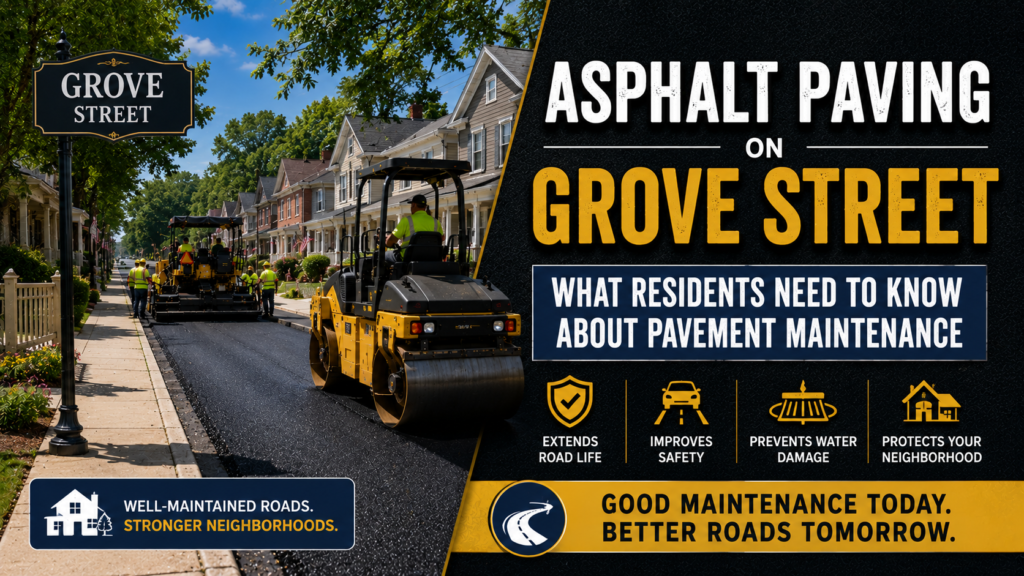
Grove Street in Avoca, Pennsylvania, carries the name of a simple, evocative feature the kind of tree-shaded residential corridor that defines the character of small Pennsylvania boroughs. Streets like Grove Street are home to families who have lived in the neighborhood for generations, and the properties along them reflect both the pride of long-term ownership and the natural wear that comes with aging infrastructure.
In neighborhoods like this, asphalt driveways and nearby pavement surfaces are highly visible features of every property. They are also among the more misunderstood aspects of home maintenance often neglected during good years and then presenting a crisis of crumbling, cracked, or potholed pavement that seems to require complete replacement. Understanding the life cycle of asphalt and the maintenance steps that can prevent premature failure is valuable knowledge for any Asphalt Contractor Grove Street homeowner.
How Asphalt Ages: A Natural Process
Asphalt is not static it changes continuously from the moment it is laid. Understanding how and why it ages helps explain why maintenance matters and when different interventions are appropriate.
Oxidative Hardening: From the moment asphalt is placed, the bitumen binder begins reacting with atmospheric oxygen. This oxidation progressively hardens and embrittles the binder, making the asphalt less flexible and more prone to thermal cracking. The rate of oxidation is accelerated by heat and UV exposure which is why southern exposures and areas in direct sunlight age faster than shaded sections.
Visually, oxidation manifests as a color change: fresh asphalt is deep black; as it oxidizes, it fades to gray. A gray asphalt surface is a sign that the binder has lost significant flexibility and the surface is approaching the stage where more serious deterioration will begin.
Thermal Cracking: As the binder hardens with age, asphalt loses its ability to flex during temperature changes. In Pennsylvania’s cold winters, the pavement contracts as temperatures drop. Eventually, the tensile stress from contraction exceeds the strength of the brittle binder, and the surface cracks typically in transverse (perpendicular to the road) patterns. Thermal cracks are a predictable feature of aging asphalt in cold climates.
Moisture Damage: Water is asphalt’s persistent adversary. Through surface cracks or porous aged surfaces, water infiltrates into the pavement structure. Repeated saturation and freeze-thaw cycling weakens the adhesion between the binder and aggregate particles a process called stripping. As stripping progresses, the aggregate loses its anchoring within the binder matrix, leading to surface raveling and pothole formation.
Traffic Loading: Every vehicle pass applies a load to the pavement that causes micro-level flexing of the surface. Over time millions of load cycles for busy surfaces this cumulative flexing causes fatigue cracking, typically recognized as alligator cracking. The rate of fatigue cracking is highly sensitive to pavement thickness: a pavement one inch thicker than necessary may last two or three times longer under the same traffic.
The Art of Pothole Repair: More Than Filling a Hole
Potholes are the most dramatic and immediately visible form of asphalt distress, and they are a particular source of frustration for property owners on residential streets like Grove Street. But effective pothole repair is not as simple as it might appear throwing asphalt into a hole and compacting it is a temporary fix that rarely lasts if the underlying cause is not addressed.
A professional approach to pothole repair involves:
Identifying the Cause: Most potholes form because water has infiltrated through surface cracks and weakened the base layer. Before repairing the surface, the source of water infiltration must be identified and addressed. If the surrounding pavement has widespread cracking that will continue to allow water in, surface patching alone will not produce a durable result.
Saw-Cutting: Professional patching begins by saw-cutting the perimeter of the repair area in straight lines, creating clean, vertical edges. This is critical for the longevity of the patch irregular, raveled edges do not bond well to new material, and the patch will crack and fail along the edge seam prematurely.
Full-Depth Removal: The failed material is removed down to firm base. In many cases, particularly after significant moisture damage, the base material within the pothole area must also be removed and recompacted or replaced before the asphalt patch is installed.
Tack Coat Application: A tack coat of asphalt emulsion is applied to the vertical cut edges and the base of the excavation before new asphalt is placed. This ensures adhesion between old and new material.
Filling and Compaction: Hot mix asphalt is placed in the excavation and compacted with hand tampers or plate compactors. If the depth requires multiple lifts, each lift is compacted before the next is placed.
Surface Flush: The final surface of the patch is carefully finished to match the elevation of the surrounding pavement, avoiding a bump or depression that would collect water or create a driving disturbance.
This thorough process produces repairs that can last for years. By contrast, “throw and roll” patching common in emergency or temporary repair situations typically lasts only weeks or months in Pennsylvania’s climate before the patch fails again.
Asphalt vs. Concrete: Choosing the Right Material for Residential Surfaces
A question that often arises among homeowners considering driveway replacement is whether to choose asphalt or concrete. Both are legitimate options with distinct advantages and limitations:
Asphalt Advantages:
- Lower initial installation cost in most markets
- Faster return to service (typically 24–48 hours vs. several days for concrete)
- Better performance in freeze-thaw climates flexibility reduces cracking from thermal cycling
- Easier to repair damaged sections can be patched seamlessly
- Fully recyclable at end of life
- Better traction in cold, wet conditions
Asphalt Disadvantages:
- Requires periodic sealcoating maintenance (every 3–5 years)
- Can soften in extreme heat (though polymer-modified mixes largely address this)
- Fades to gray with age if not sealcoated
- Life span (15–30 years with maintenance) may be less than well-maintained concrete (30–50+ years)
Concrete Advantages:
- Very long service life when properly installed
- Higher load-bearing capacity
- Less prone to rutting under heavy loads or heat
- Minimal maintenance required in first 20 years
Concrete Disadvantages:
- Higher initial cost
- Longer cure time before use
- More prone to cracking in freeze-thaw climates
- Individual slab repairs are visible (less aesthetically seamless)
- More affected by road salts and deicers
For most homeowners on residential streets in Pennsylvania like Grove Street, asphalt is the more practical choice given the climate, typical driveways sizes, and the balance of initial cost versus maintenance. However, for certain specific applications retaining walls, drainage channels, entry aprons concrete or a combination of materials may be preferable.
Winter Paving and Cold-Weather Asphalt: Separating Fact from Fiction
A common question from homeowners in Pennsylvania is whether asphalt can or should be installed in winter. The straightforward answer is: true hot mix asphalt has temperature limitations for installation, but experienced contractors can work in cooler conditions than many assume with caveats.
The Lower Limit: Hot mix asphalt (HMA) should generally not be placed when ambient temperatures are below 50°F for surface courses, or when the surface being paved is below that temperature. At colder temperatures, the mix cools too rapidly for adequate compaction.
Exceptions and Workarounds: Warm mix asphalt (WMA) technologies produce asphalt that can be placed and compacted at lower temperatures, extending the practical paving season. Additionally, base course paving can sometimes proceed at lower temperatures because the thicker layer retains heat longer.
Cold Patch: For emergency repairs during winter, cold mix asphalt which uses an emulsified binder that does not require heating can be used to temporarily fill potholes and cracks. Cold patch is not a permanent fix; it is a temporary measure to keep surfaces safe until proper hot mix repairs can be performed in warmer weather.
In general, the best time for major residential paving projects in the Avoca area is April through October, when temperatures are reliably above the threshold for high-quality HMA placement and compaction.
Tree Canopy and Asphalt: Grove Street’s Distinctive Challenge
The name “Grove Street” suggests something of the tree canopy that may characterize it and therein lies a specific challenge for asphalt maintenance in this neighborhood. Mature trees and asphalt pavement have a complicated relationship:
Shade: Tree canopy reduces UV exposure, which slows oxidative hardening of the asphalt binder. This is actually beneficial for pavement longevity. Shaded surfaces retain their flexibility longer than sun-exposed ones.
Moisture Retention: The flipside of shade is that shaded surfaces dry more slowly after rain, keeping the pavement damp for longer periods. Prolonged moisture exposure can accelerate biological growth (moss and algae) and, on compromised surfaces, infiltration.
Root Intrusion: The most serious tree-related pavement challenge is root growth. As large trees mature, their root systems extend radially from the trunk and those roots do not stop at pavement edges. Roots growing beneath asphalt can lift and crack the surface from below, creating raised ridges, cracking, and tripping hazards.
Managing root intrusion requires either root barriers (installed during construction or in conjunction with nearby tree plantings) or, in severe cases, selective tree removal or root pruning. When significant root disruption is present, simply patching the surface crack is futile the root must be addressed.
Conclusion
Grove Street is a neighborhood where the everyday character of a Pennsylvania small borough is most evident in its homes, its trees, and the streets and driveways that connect them. Asphalt pavement is as much a part of that character as anything else, and understanding how it works, how it ages, and how it can be maintained empowers homeowners to protect their investment and contribute to the neighborhood’s overall quality.
From the science of asphalt aging to the correct technique for pothole repair, from the choice between asphalt and concrete to the seasonal realities of Pennsylvania paving knowledge is the foundation of good decisions. And good decisions, made consistently over time, are what keep driveways and pavement surfaces serving their communities well.